
 1 hour ago
4
1 hour ago
4
Its details are instantly recognisable: sweet, tender, and funny, there’s a profound universality in its specificity. The song’s chorus – “I wanna share files with you” – is attributed to Squiddd themselves. It’s the sole fragment of memory of a song about the show and its aftermath, detailed so beautifully by Cornfield.
It’s also an impeccable jumping off point for the record as a whole and for my conversation with Cornfield, which takes place on a crisp spring afternoon. The more I listen to Hurts Like Hell, the more “Squiddd” seems like its heart, thematic threads emanating outwards; ultimately, Hurts Like Hell is about Cornfield’s life in music, in that music – and her community around it – shapes every small detail.
“The writing about a life in music just happened and then it became a massive thematic thread,” she tells me. “I came of age on the scene and all of those memories and relationships are just so embedded in how I see the world now.” She goes on to say that even “the musical references that are on the record – Sharon Van Etten, Neil Young, for example – were a huge part of those formative moments in my life, and they are so present almost come out as their own characters on the record.”
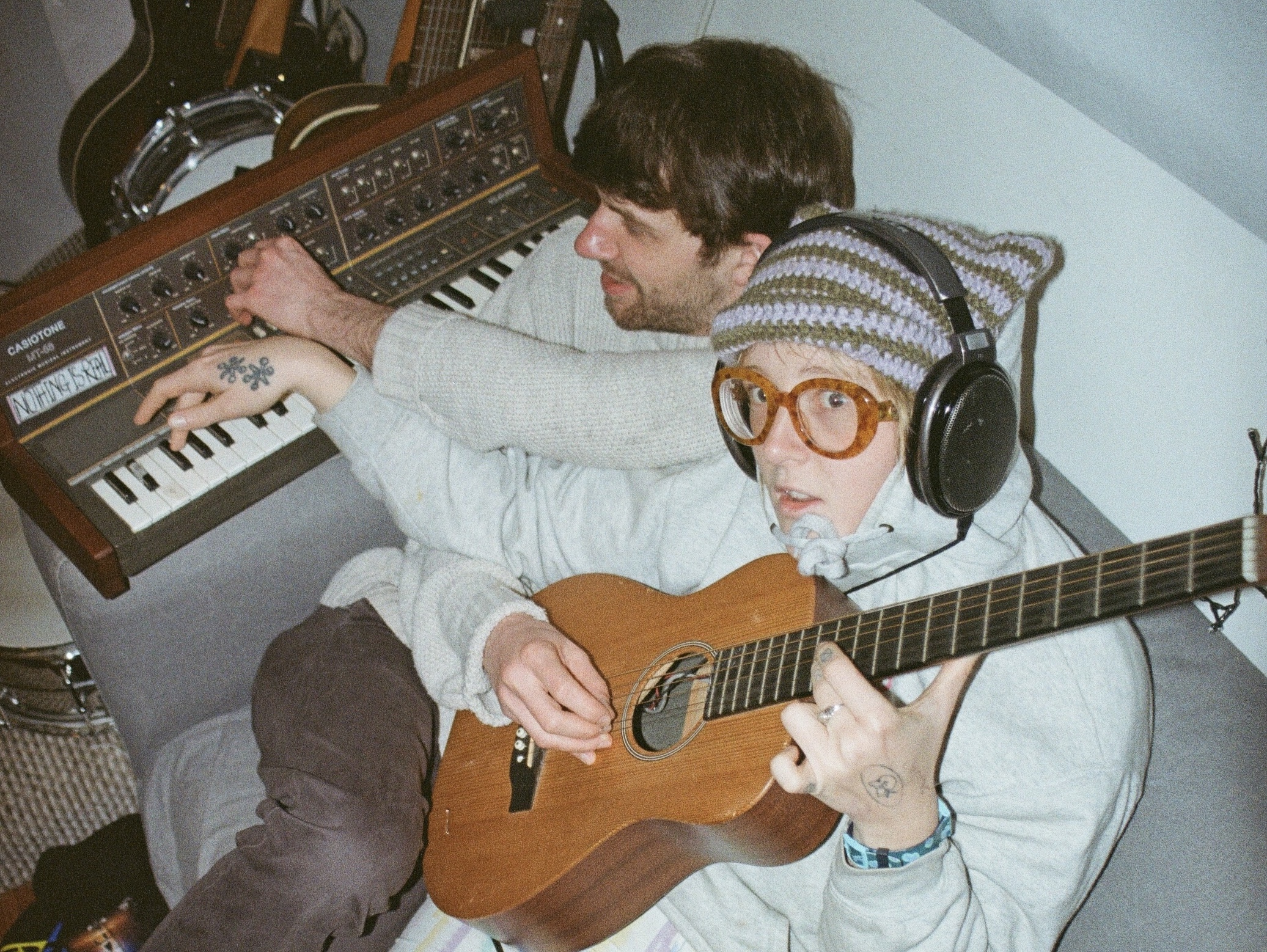
Cornfield’s life in music is represented stunningly by the incredible cast of musicians that colour her record, with her band comprising Palehound’s El Kempner (guitar/vocals), Lake Street Drive’s Bridget Kearney (bass/vocals), Adam Brisbin (guitar/pedal steel), and Sean Mullins (drums), plus key contributions from Núria Graham on piano, and Daniel Pencer on saxophone. Cornfield and producer Phil Weinrobe then recruited Feist, Big Thief’s Buck Meek, Christian Lee Hutson, and Maia Friedmanto to sing on the album. It’s an extensive and inspiring range of talent which doesn’t detract from the singularity of Cornfield’s songwriting.
“I met Feist through a touring moms group chat!” Cornfield laughs as she reflects on the litany of “dream collaborators” on the record. “I thought she’d be so busy, but Phil [Weinrobe, producer] got in touch with her and asked her if she wanted to sing – an hour later we were making plans!”
Cornfield speaks about Weinrobe’s contribution with great warmth, explaining that this is the first time she’d ceded this amount of creative control to a producer. They recorded the album in only six days, an unusually short amount of time.
“I really like having limitations – a deadline for having songs ready, or a date booked for touring – I find that really helpful,” she explains, “and that’s how Phil works. He finds the freedom in limitations. Even though we were only in the studio for six days, we were communicating for months prior and he was telling me about which songs were resonating with him and I was sending him voice notes. He was sending me back to the drawing board, giving me real direction. He’d say “I really love ‘Lost Leader’, can you give me a sequel to that?” I made my last record with Josh Kaufmann, and in that context I came to the studio with the songs and we went from there. This was the first instance in which the producer was a co-collaborator.”
Initially, Cornfield thought that some of Weinrobe’s sonic suggestions were somewhat extreme: “When he threw NRBQ at me, I was a little concerned!” she says of the Louisville genre benders. “This notion of deep country and deep funk!”
Ultimately, though, securing some important sonic consistencies – pedal steel in the mix and “a real deep-sitting rhythm section” – gave the record its strong identity, even though there was no fixed-in-stone vision. The result is sleepy but captivating folk storytelling. And this serendipity was reflected in the song choices that came to fruition. Of “Lucky” and the closer, “Bloody and Alive”, Cornfield states, “I had, for the first time, a lot of little fragments that just came together in the studio like nothing I’d experienced before.”
Speaking to Cornfield, I get the sense that much of the feel of the record came from a newfound sense of malleability, a shedding of egos and a desire to say ‘yes’ to more – something she describes as “a total sense of openness to ideas and people.” This is reflected in the nature of her songwriting too, with personal songs and more impressionistic, character-based ones sitting side by side – the personal and political intertwined, the universal and the specific one and the same.
Taking the likes of Bill Callahan, David Berman, and Andy Schauff for inspiration, Cornfield started to see both the personal approach and inhabiting a character as “fundamentally linked”. She was drawn to little vignettes, following the threads to see where they led her.
“The song that sounds most like a character study is ‘Lost Leader’,” she says of the warm, slumping modern-folk classic. “I had no idea where it was going, but suddenly it was so fully formed. I loosened up – this was the first time I inhabited different characters in the writing and I feel that spilled over into how it was recorded. We decided who wanted to be in the band but nobody had heard a note before the sessions started.” The word ‘ego’ comes up a lot in our conversation, and the gradual erosion of it in Cornfield’s creative practice seems revelatory. It also relates to another seismic shift in her life: motherhood.
“I had a year and a half when I was full-time with my daughter, and when she went to daycare, that’s when I got back into that writing space,” Cornfield says. She says that her entire frame of reference was turned on its head – now focused on watching a tiny person grow, getting pulled out of herself and her previous reality.
“What it did for me was to allow me to experience things for the first time again, but with her,” Cornfield says – “seeing it through her perspective. Listening to a song that I’d heard a million times before, but with her.”
It’s striking how Cornfield’s attitudes around parenthood and creative practice sit so well together. She jokes that they are both joyful and unglamorous processes that allow you to shed your ego.
It is in light of this that the golden thread of the record becomes apparent; in every aspect of its makeup, it is about seeing things in a new light.
“I couldn’t have made this record without reflecting back on moments and experiences with a new empathy or understanding,” she says. “This has been my life – coming of age in music and loving and learning with it.”
Hurts Like Hell is a delicate, beautiful, and articulate expression of the rich aspects of her life that Cornfield invites me to discuss – a world constructed from fragments of experience that is direct, vulnerable, and emotionally rewarding.









 English (US) ·